Zirconia crowns
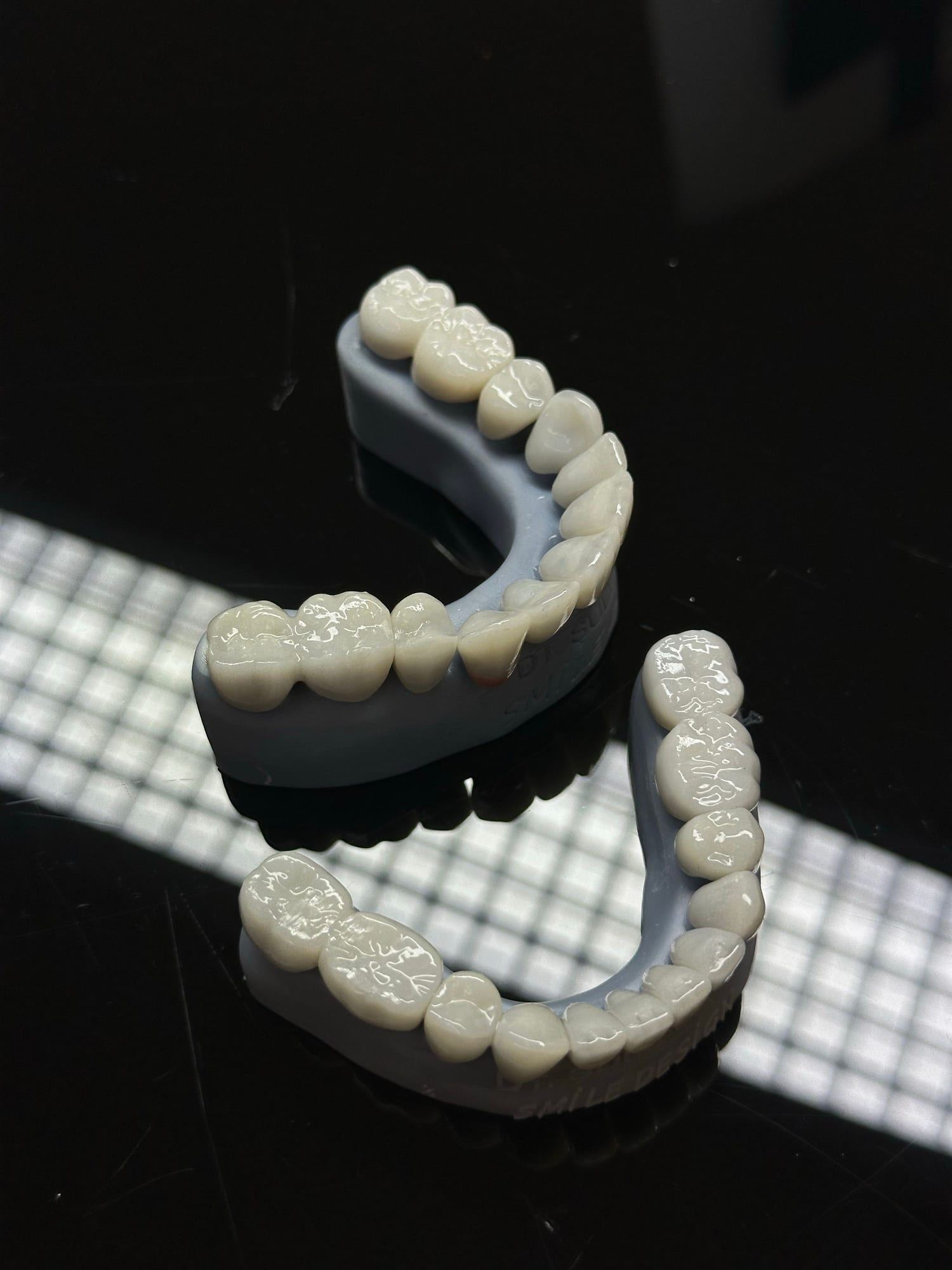
A crown covers the whole visible part of a tooth, restoring its shape and protecting what remains of it. Zirconia is a ceramic material strong enough for back teeth and free of any metal core, which is what allows it to avoid the grey line at the gum that older metal-backed crowns eventually show. A crown is a bigger intervention than a filling or a veneer, and it is the right answer only when there is not enough sound tooth left for something smaller.
Delivered by: Dentist Saliha Yıldırım
Who it suits
- Teeth broken or worn beyond what a filling can hold
- Teeth after root canal treatment, which are brittle and often fracture without full coverage
- Teeth with very large existing fillings where the remaining walls are undermined
- Restorations on implants
- Bridge retainers, where the crown supports a replacement tooth alongside it
- Patients who want a metal-free restoration
Who it does not suit
- Teeth that could be restored with a filling, an inlay or a veneer — a crown removes far more tooth structure
- Teeth with active untreated decay under the intended margin
- Teeth with insufficient remaining structure to retain a crown, which may need a post or may not be saveable
- Patients with untreated gum disease
- Front teeth where maximum translucency is the priority and a glass-ceramic would look better
How the treatment works
The tooth is prepared under local anaesthetic — reduced on all surfaces by roughly one to two millimetres to make room for the crown. A digital scan or impression is taken, a temporary crown is fitted, and the definitive crown is made in the laboratory. At the fitting appointment the fit, contact points, shade and bite are checked before it is cemented.
Treatment stages
- 01
Assessment
Radiographs and examination establish whether a crown is genuinely necessary, and whether the tooth needs root canal treatment first.
- 02
Preparation
The tooth is reduced under local anaesthetic and any decay removed. Where too little structure remains, a build-up or post is placed.
- 03
Scan and temporary
A digital scan or impression is taken and a temporary crown protects the tooth in the meantime.
- 04
Laboratory fabrication
The crown is milled from zirconia and either left monolithic or layered with ceramic for a more natural surface.
- 05
Fitting
Fit, contacts, shade and bite are checked, then the crown is cemented and the bite refined.
Materials and options
Monolithic zirconia
Milled from a single block. The strongest option and effectively immune to chipping, at the cost of some translucency. The usual choice for molars.
Layered zirconia
A zirconia core with hand-layered ceramic on the visible surface. Better optically, slightly more prone to chipping of the layered ceramic.
Lithium disilicate
Not zirconia, but frequently the better answer for front teeth, where translucency matters more than absolute strength.
Recovery
Sensitivity for a few days after preparation is normal, particularly to cold. The gum around the margin may be tender briefly. The bite is checked at fitting, but if it feels high after a day or two it needs adjusting rather than tolerating.
Aftercare
The crown itself cannot decay, but the tooth beneath it can, and the margin at the gum line is where that happens. Floss or use interdental brushes around every crown daily. If you grind, a night guard protects both the crown and the tooth under it.
What affects the cost
- Number of crowns
- Monolithic or layered zirconia, or a glass-ceramic alternative
- Whether a core build-up or post is needed first
- Whether root canal treatment is required before the crown
- Whether the crown forms part of a bridge
Travel considerations
Crowns fit a single trip well: no biological healing, only laboratory time. Allow four to six days so that the fitting appointment is not on the morning of your flight — a crown that needs a small adjustment is much easier to solve while you are still in the city.
Alternatives
Inlay or onlay
A laboratory-made partial restoration that covers only the damaged part of the tooth. Preserves considerably more structure where the walls are still sound.
Large filling
Where enough sound tooth remains, a direct restoration avoids crowning altogether. Less durable in heavily broken teeth.
Veneer
For front teeth needing appearance changes rather than structural repair.
Extraction and implant
Where the tooth cannot be restored predictably, replacing it may be better than crowning something that will fracture.
Risks and limitations
- Substantial and irreversible removal of tooth structure
- Nerve inflammation after preparation, occasionally requiring root canal treatment afterwards
- Decay at the margin over time where cleaning is inadequate
- Chipping of layered ceramic, though monolithic zirconia rarely chips
- Gum recession exposing the margin in later years
- Fracture of the underlying tooth, particularly in root-treated teeth
- The crown loosening or debonding
Common questions
How long does a zirconia crown last?
Commonly ten to fifteen years or more. What usually ends a crown’s life is decay at the margin or fracture of the tooth beneath, not failure of the ceramic — which is why cleaning around it matters more than the material.
Zirconia or porcelain-fused-to-metal?
Zirconia is metal-free, so it avoids the grey line that appears at the gum as PFM crowns age, and it is comparable in strength. There is little argument for a metal core in most contemporary cases.
Do I need root canal treatment before a crown?
Only if the nerve is already damaged or infected. Crowning does not automatically require it. Occasionally a tooth becomes symptomatic after preparation and needs it afterwards, which is a known risk rather than a failure.
Will it match my other teeth?
Shade is selected against your natural teeth. A single crown among natural front teeth is the hardest match in dentistry — a glass-ceramic is often the better material there, and that recommendation will be made where it applies.
Can crowns be done in one trip?
Yes. Four to six days covers preparation, laboratory work and fitting for a normal number of units.
Start with the assessment.
Send your photographs and a short description of what is bothering you. You will receive a first assessment and, where possible, a written preliminary plan — before any question of travel comes up.
Free of charge · No obligation · German, English or Turkish