Root canal treatment
Root canal treatment removes infected or dying pulp — the nerve and blood supply inside a tooth — cleans and shapes the canals that held it, and seals them. It is what allows a tooth with an infected nerve to be kept rather than extracted. The reputation it carries is largely undeserved: performed under proper anaesthetic it is not a painful procedure, and it usually relieves pain rather than causing it.
Delivered by: Dentist Saliha Yıldırım
Who it suits
- Teeth with irreversible pulp inflammation, typically presenting as prolonged pain to hot or cold
- Teeth with an infected nerve and an abscess at the root tip
- Teeth where decay has reached the pulp
- Teeth that have died after trauma, often signalled by darkening
- Teeth needing pulp removal before extensive restorative work
Who it does not suit
- Teeth fractured below the gum or with insufficient structure to restore afterwards
- Teeth with severe bone loss from advanced gum disease
- Teeth where the canals cannot be adequately accessed or cleaned
- Cases where extraction and replacement is the more predictable long-term answer, which is sometimes the honest recommendation
How the treatment works
Under local anaesthetic the tooth is isolated, usually with a rubber dam, and an opening is made to reach the pulp chamber. The canals are cleaned and shaped with fine instruments and irrigated to remove bacteria, then dried and sealed with a root filling material. The access opening is closed, and because a root-treated tooth is brittle, a crown or substantial restoration usually follows to prevent fracture.
Treatment stages
- 01
Diagnosis
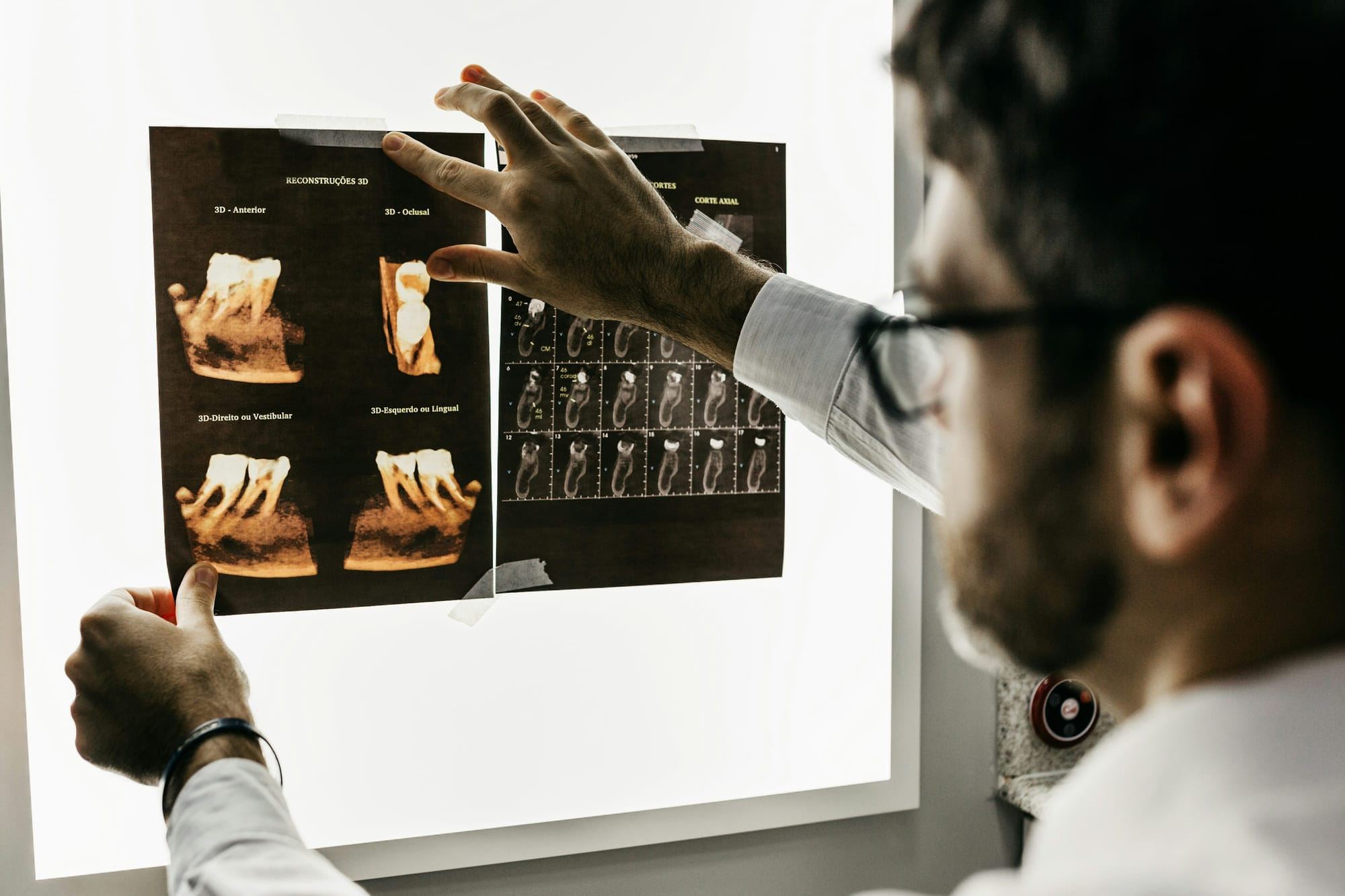
Radiographs and pulp testing establish whether the nerve is genuinely non-vital and whether the tooth is restorable at all.
- 02
Access and cleaning
Under local anaesthetic and isolation, the canals are located, cleaned, shaped and irrigated.
- 03
Filling the canals
The canals are dried and sealed. In straightforward cases this happens at the same appointment; where there is active infection it may be done at a second visit.
- 04
Restoring the tooth
A core build-up and usually a crown, since a root-treated tooth loses a great deal of its resistance to fracture.
Materials and options
Gutta-percha
The standard root filling material, a stable natural polymer used with a sealer to fill the cleaned canal space.
Core build-up materials
Composite or a post-and-core where a great deal of tooth structure has been lost, to give the crown something to hold onto.
Isolation
A rubber dam keeps the tooth dry and free of saliva during treatment. It is not optional in careful endodontics — it is a substantial part of why treatment succeeds.
Recovery
Some tenderness to biting for a few days afterwards is normal, particularly where there was infection beforehand, and ordinary painkillers are usually sufficient. Avoid chewing hard on the tooth until the definitive restoration is in place.
Aftercare
A root-treated tooth has no nerve, so it will not warn you about new decay with pain. That makes regular examination and radiographs more important, not less. Get the definitive crown placed rather than leaving a temporary in place indefinitely — most root-treated teeth that fail, fail by fracture.
What affects the cost
- Which tooth: front teeth have one canal, molars typically three or four
- Whether the treatment is a first-time procedure or a re-treatment of a previous root filling
- Whether a post and core build-up is needed
- The restoration that follows, which is normally a crown
Travel considerations
Root canal treatment is not a reason to travel on its own, but it frequently appears within a larger plan — a tooth that needs treating before it can be crowned, or before it can carry a bridge. It is scheduled early in the trip so the definitive restoration can be completed before you fly home, rather than leaving you abroad with a temporary.
Alternatives
Extraction
Removing the tooth is faster and cheaper. It then leaves a gap that usually wants replacing, at which point the total cost exceeds the root canal.
Extraction and implant
Where the tooth is not predictably restorable, replacing it can be the better long-term decision.
Re-treatment
Where a previous root filling has failed, redoing it is often possible before considering extraction.
Risks and limitations
- Persistent infection requiring re-treatment or, occasionally, surgery at the root tip
- Instrument separation within a canal
- Canals that cannot be fully located or cleaned, particularly in complex anatomy
- Fracture of the tooth, especially if left without full-coverage restoration
- Post-operative discomfort for several days
- Eventual failure requiring extraction — root canal treatment is highly successful but not universally so
Common questions
Is root canal treatment painful?
Not under proper local anaesthetic. Most patients arrive in pain from the infected nerve and leave with it resolved. Some tenderness for a few days afterwards is normal.
Do I definitely need a crown afterwards?
For back teeth, almost always — they take heavy load and a root-treated tooth fractures readily without full coverage. Front teeth with minimal loss of structure can sometimes be restored with a filling instead.
How long does a root-treated tooth last?
Well-treated and properly restored, it can last for decades. The main causes of eventual loss are fracture and new decay, both of which are influenced by whether the definitive restoration was placed promptly.
Can it be done in one appointment?
Often yes, particularly where there is no active infection. Where there is, a two-stage approach with medication between visits is sometimes the better course.
Should I just have the tooth out instead?
Extraction is cheaper on the day and more expensive over a decade, once you account for replacing the gap. Where the tooth is restorable, keeping it is usually the better decision — and where it is not, you will be told so directly.
Start with the assessment.
Send your photographs and a short description of what is bothering you. You will receive a first assessment and, where possible, a written preliminary plan — before any question of travel comes up.
Free of charge · No obligation · German, English or Turkish